The federal budget model behind the book: what the debt looks like today, what full implementation costs, how it gets paid for, and what changes for an individual household. Figures are drawn from Chapter 20 and Chapter 10 of the 8 HARPS book.
Net expendable income is what a household has left after taxes and unavoidable costs of living, the real measure of whether a family is getting ahead. The chart below compares that number today against the same household under 8 HARPS, fully implemented.
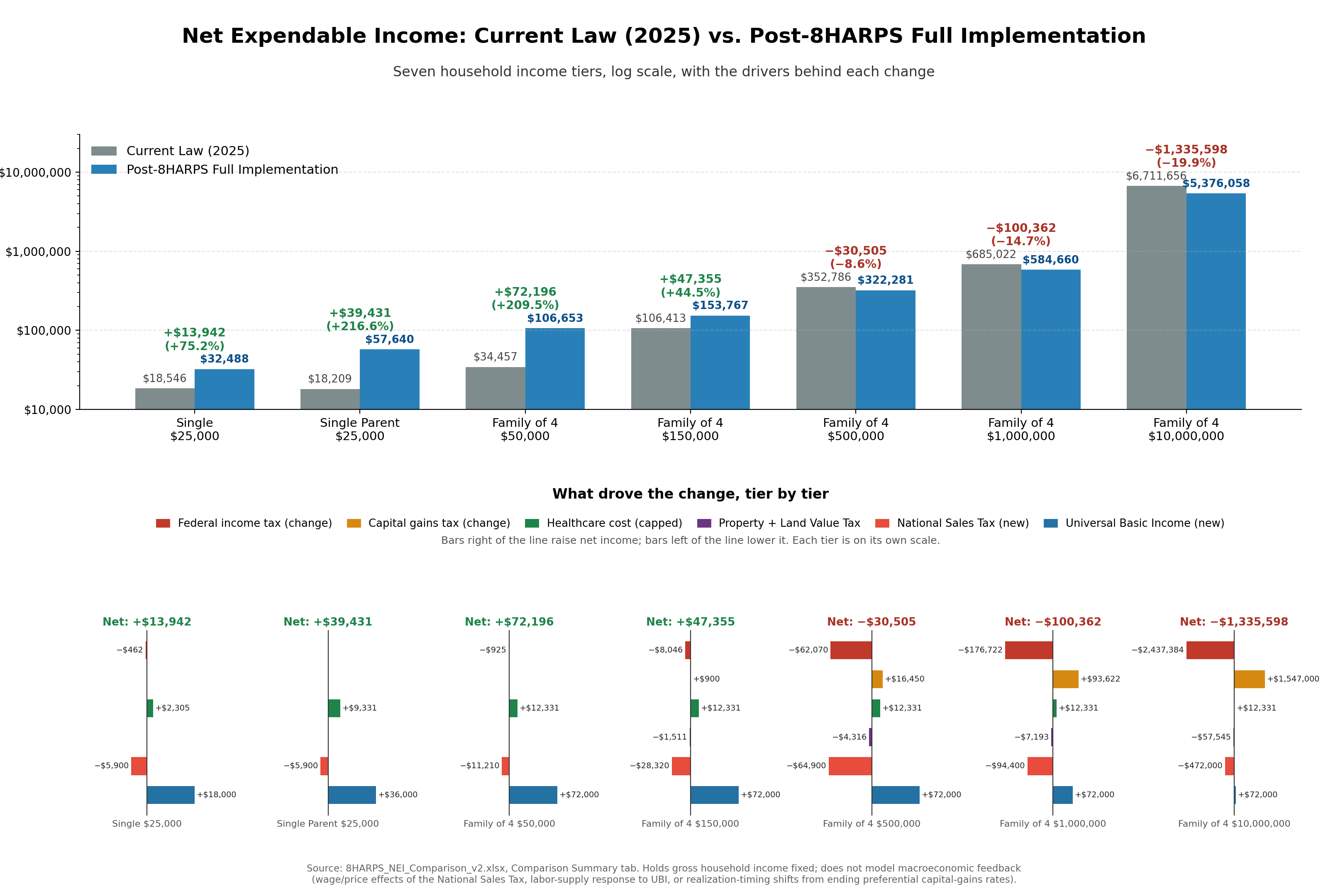
How to read this chart: Single and Single Parent are one-person and single-parent households, shown at a $25,000 household income for comparison. The remaining five tiers all represent a family of four, at the stated income level, from $50,000 up to $10,000,000. The gray bars show net expendable income under current law in 2025. The blue bars show the same household's net expendable income once 8 HARPS is fully implemented, with the dollar and percent change labeled above each pair. Beneath the main chart, a small breakdown for each tier shows exactly which drivers, the Universal Basic Income, the National Sales Tax, capped healthcare costs, federal income tax, capital gains tax, and property and land value tax, produced that tier's result: bars to the right of the line raise net income, bars to the left lower it.
Before 8 HARPS adds a single dollar of new spending, the federal government is already carrying a debt load that shapes every other number in this book.
As of mid-2026, roughly $115,000 for every living American, adult and child alike.
Projected for fiscal year 2026, or 5.8 percent of GDP, nearly double the fifty-year average of 3.8 percent.
The federal government now spends more servicing existing debt than on most individual categories of the budget, a bill paid before a single service is delivered.
The Office of Humanity, which delivers healthcare, housing, education, and the Universal Basic Income, is by far the largest line item. The book does not treat that cost as a blank check.
The gross program cost of the Office of Humanity, fully phased in, runs to roughly $11.2 trillion a year. That figure is not the net new burden on the federal budget. It substantially overlaps with programs the federal government already funds: Social Security, Medicare, Medicaid, the Earned Income and Child Tax Credits, SNAP, Supplemental Security Income, housing assistance, child nutrition programs, and the Children's Health Insurance Program together already cost roughly $3.7 trillion a year, and Medicare-anchored provider reimbursement, direct drug price negotiation, and capped cost-sharing are estimated to add a further $1.1 trillion a year in healthcare cost-control savings. Crediting both brings the realistic net new federal commitment for the Office of Humanity to roughly $6.4 trillion a year.
Every other new office in the book is, by comparison, a rounding error. The consolidated product, environmental, and data-safety functions proposed under the Office of Public Safety and the new Data Protection Authority are estimated to add tens of billions of dollars a year combined, a small fraction of one percent of the Office of Humanity's cost.
Chapter 20 itemizes ten dedicated revenue mechanisms that together raise an estimated $11.2 trillion a year in new federal revenue against $7.6 trillion a year in new program costs, turning today's deficit into a projected surplus.
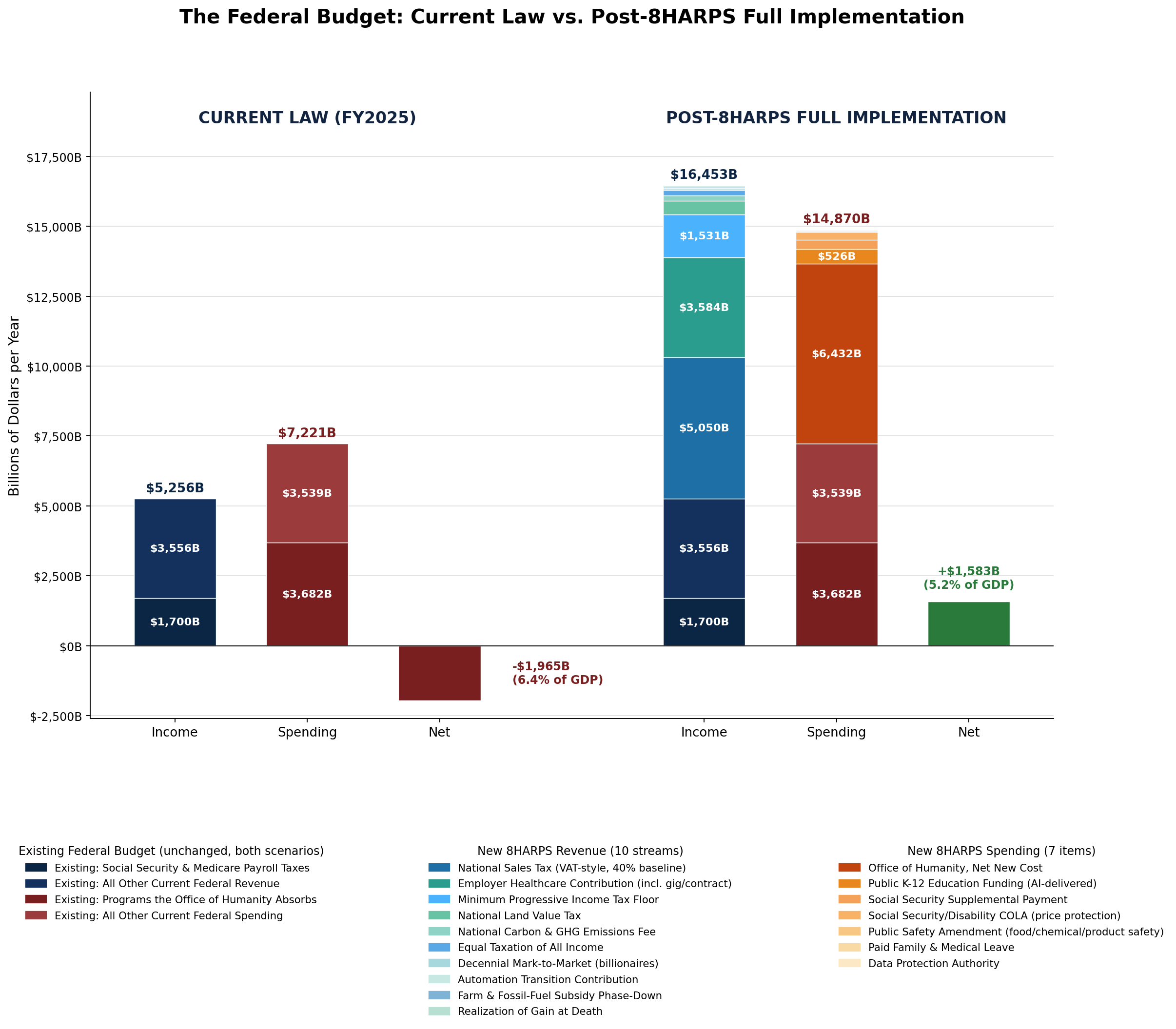
The chart below puts the entire federal budget on one page: what the government collects and spends today, side by side with what it would collect and spend once 8 HARPS is fully implemented. The existing federal budget, shown in navy and dark red, carries forward unchanged in both scenarios. Every other segment is new revenue or new spending added by 8 HARPS.
| Revenue Source | Amount per Year |
|---|---|
| National Sales Tax (VAT-style, 40% baseline rate) | $5,050B |
| Employer Healthcare Contribution (incl. gig and contract workers) | $3,584B |
| Minimum Progressive Income Tax Floor | $1,531B |
| National Land Value Tax | $492B |
| National Carbon and Greenhouse-Gas Emissions Fee | $187B |
| Equal Taxation of All Income (capital gains and carried interest) | $190B |
| Decennial Mark-to-Market on Billionaire Wealth | $50B |
| Automation Transition Contribution | $45B |
| Farm and Fossil-Fuel Subsidy Phase-Down | $36B |
| Realization of Gain at Death (stepped-up basis closed) | $32B |
| Total New 8 HARPS Revenue | $11,198B |
| Program | Amount per Year |
|---|---|
| Office of Humanity, net new cost (after crediting existing programs and healthcare savings) | $6,432B |
| Public K-12 Education Funding (AI-delivered, financed by the Land Value Tax) | $525.6B |
| Social Security Supplemental Payment (fairness fix) | $337B |
| Social Security and Disability Cost-of-Living Adjustment (fairness fix) | $274B |
| Public Safety Amendment (food, chemical, and product safety) | $32.5B |
| Paid Family and Medical Leave | $45B |
| Data Protection Authority | $3B |
| Total New 8 HARPS Spending | $7,649B |
Add the unchanged existing budget to each side and the totals are $16,454 billion a year in revenue against $14,870 billion a year in outlays, a projected surplus of about $1,583 billion a year, or 5.2 percent of GDP, versus today's $1,965 billion deficit, or 6.4 percent of GDP. Chapter 20 describes further, smaller measures, a higher corporate tax rate and documented Pentagon waste cuts, that could grow that surplus to roughly $1,840 billion a year, or 6.0 percent of GDP, though the base plan does not require them to balance the books.
The Federal Debt and the Federal Budget Amendment does not raise the revenue described above. What it does is enforce the discipline that keeps the government from drifting back into deficit once the plan is enacted.
A constitutional cap on the annual structural deficit, tighter than the European Union's 3 percent benchmark, phased in from today's 5.8 percent over five years.
Every federal program faces zero-based review on a five-year cycle, with a matching five-year sunset on federal tax expenditures.
The debt ceiling standoff is replaced by automatic borrowing authority tied to appropriations Congress has already enacted, checked by a citizen referendum backstop rather than a threat to default.
The federal budget model matters because of what it buys at the household level. Here is what changes for the average American under full implementation.
Every American, from birth to death, not adults only, receives a Universal Basic Income of $1,500 a month. It is paid in full from the day the amendment takes effect, not phased in as the new revenue streams ramp up.
Physician, hospital, prescription drug, dental, and vision care are covered without a monthly premium. Free at the point of service does not mean free of any charge: Congress may set a modest per-visit charge, $100 by default, and a modest annual per-person deductible, $1,000 by default. Neither figure can rise without limit. The per-visit charge is capped at seven percent of a single month's Universal Basic Income payment, and the deductible is capped at seven percent of twelve months' worth of that same payment, so the cost of seeking care can never outpace the income floor every citizen receives.
Instead of raising income tax rates on ordinary wages, the financing model leans on a national consumption tax with necessities exempted, a land value tax weighted toward investment and second-home real estate rather than a primary residence, and equal tax treatment of capital gains and carried interest for those with investment income. A single employer-paid contribution replaces today's patchwork of employer-provided health insurance and retirement contributions, extended for the first time to gig and contract workers who typically receive neither.
These are order-of-magnitude estimates built from the same kind of external cost studies Congress relies on when scoring comparable proposals, not a precise federal score, which only the Congressional Budget Office can ultimately produce once implementing legislation exists. The full methodology, every assumption, and the complete narrative on the fiscal model are in Chapter 20 of the book.